There was a time when I had a fairly uncomplicated faith in the medical profession. You got sick, you went to a doctor, the doctor examined you, told you what was wrong, and then, ideally, made you better. This was more or less the arrangement. There was a certain reassuring simplicity to it. You were the patient, they were the doctors, and somewhere between the two of you there existed a body of knowledge, experience and professional responsibility that was supposed to work in your favour.
I have gradually come to suspect that this arrangement was either hopelessly naïve or that something has gone rather spectacularly wrong in the meantime.
Let me explain.
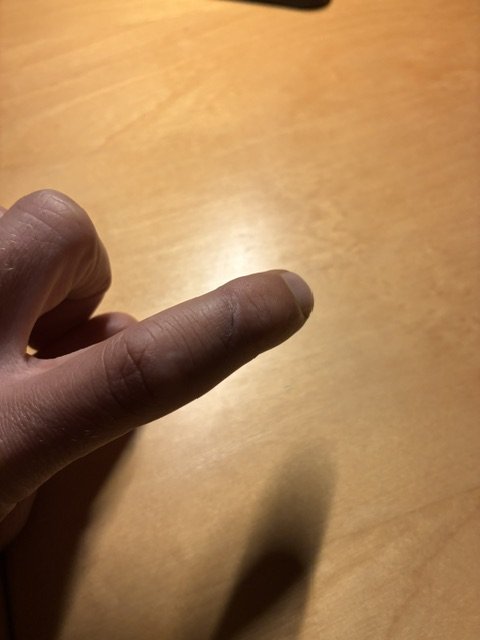
About three weeks ago, while converting my van somewhere in France, I managed to cut my finger rather badly with a knife. Not particularly heroic, I admit. There I was, engaged in the noble enterprise of constructing a mobile home, and suddenly found myself bleeding rather enthusiastically over the plywood. The bleeding was sufficiently impressive that a couple of ordinary plasters were not going to settle the matter.
I noticed two people standing in the distance in the car park and went over to ask for help. As it happened, they were paramedics. They bandaged the finger, did what they could, and then advised me to visit a pharmacy to have the wound disinfected. They themselves, somewhat surprisingly, did not have any disinfectant with them. I thanked them and went to the pharmacy.
The pharmacist examined the wound and suggested that I might be better off visiting the local emergency department. It looked rather deep, she said. Fair enough. I went.
After a considerable wait, I was eventually examined by a doctor. He studied the wound carefully and concluded that everything seemed more or less fine, although he couldn't entirely rule out the possibility that I had damaged a tendon. Because fingers, apparently, are rather complicated pieces of biological engineering, and because the hand is one of those parts of the body that surgeons prefer not to leave entirely to chance, he recommended that I visit a specialised hand surgery hospital the following morning.
An hour's drive away.
A private hospital, specialising in hand surgery.
Now, at this point, I should mention something important. My finger was working perfectly well. I could bend it, straighten it, move it in every direction. There was no pain whatsoever. I was actually in the middle of writing a song and was rather keen to get back to my guitar. The only thing my finger had been doing wrong was bleeding.
But the doctor had recommended it, so off I went.
The following morning I arrived at the specialised hospital. Another waiting room. Another considerable wait. Eventually, I was sent for an X-ray. Nobody explained much. I had the X-ray, returned to the waiting room and waited some more.
At some point a doctor appeared, said nothing of any particular significance, and informed me that he would be back shortly.
An hour later, he had not returned.
I was beginning to wonder whether the entire medical establishment had entered a collective state of meditation when one of the secretaries approached me with a form.
Would I kindly sign it?
I looked at the document. It concerned an operation costing at least €3,000, excluding various additional expenses.
I asked whether I was supposed to be having an operation.
Apparently, yes.
I asked why.
The secretary looked at me with the sort of expression one might reserve for someone who has just announced that he has no intention of paying for his own funeral.
Hadn't I seen the doctor?
No, I hadn't.
Hadn't anyone explained the procedure?
No, nobody had.
I asked whether I might perhaps speak to a doctor before signing a document authorising an operation costing several thousand euros on one of my fingers.
This, it turned out, was a surprisingly complicated request.
I was directed to another building, where I found another group of secretaries. They informed me that the surgeon was currently operating and therefore unavailable.
Understandable, of course. Surgeons do tend to be rather busy operating. It is, after all, their principal occupation.
I was sent from one desk to another, from one building to another, from one administrative department to another, in what was beginning to resemble an elaborate treasure hunt, except that the treasure was a medical explanation and the final prize was a €3,000 bill.
Meanwhile, my finger was doing wonderfully.
I could move it perfectly well. It didn't hurt. I could have played the guitar, washed the dishes, operated a small aircraft, or presumably performed most of the activities for which fingers are generally considered useful.
Yet somewhere in this establishment, an operation had apparently become an urgent necessity.
I returned to the original reception desk and explained that I wasn't particularly interested in having surgery unless somebody could first explain why it was necessary. If a doctor examined me and concluded that an operation was required, I would of course consider it. But I wasn't going to sign away several thousand euros simply because somebody behind a desk had decided that this was the next administrative step.
The secretaries exchanged glances.
I suspect I was not behaving according to protocol.
Eventually, I was given a form which, as I understood it, allowed me to leave. I signed it, wished everyone a very pleasant day, and walked out.
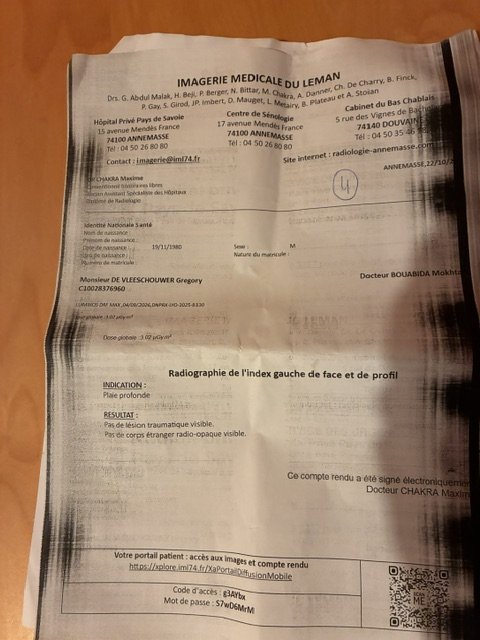
I eventually managed to get hold of the X-ray results. See photograph. As it turned out, the images showed that there was absolutely nothing wrong. Not a thing.
I went to the nearest pharmacy, bought some anti-inflammatory medication, and continued with my life. That very evening I played guitar again and worked on the song I had been writing. Two weeks later, my finger was perfectly fine.
The song is now online. It's called I Must Be an Alien. And yes, i might be an alien, who knows…
But this incident would perhaps be easier to dismiss as an unfortunate misunderstanding were it not for the fact that I have a fairly extensive history with the medical profession.
When I was in my twenties, I had a serious problem with my ankle. What followed was an extraordinary succession of specialists, diagnoses, treatments and assurances, each delivered with the sort of absolute confidence normally associated with people who have just discovered the meaning of life.
One doctor would tell me one thing. Another would tell me something completely different. I spent six months walking around in what was essentially a primitive exoskeleton, an elaborate contraption that made ordinary movement practically impossible. Six months later, it turned out to have been entirely unnecessary.
I underwent operations that, in retrospect, should never have happened. I was sent from specialist to specialist, each apparently convinced that he had finally discovered the mystery of my ankle and that I was now in the exceptionally competent hands of someone who knew precisely what he was doing.
One doctor, whom I had actually known from secondary school, seriously suggested that I might eventually have to have my foot amputated.
I have never forgotten that conversation.
If I ever encounter him again, I intend to show him photographs of myself running marathons in the mountains. Not because I particularly enjoy humiliating people, although I admit the temptation is considerable, but because I would like to establish that his prognosis was, to put it mildly, somewhat premature.
There is a particular kind of arrogance involved in telling another human being that he may lose his foot when you have no reliable idea what is actually happening.
I have no problem with doctors admitting that they don't know something. In fact, I would regard that as one of the most valuable qualities a doctor could possess. Medicine is complicated. The human body is complicated. Diagnoses are uncertain. Things go wrong. Nobody can know everything.
But there is a considerable difference between saying, 'I'm not sure, let's investigate this further,' and looking somebody in the eye with absolute certainty while recommending treatments or operations that later turn out to have been completely unnecessary.
And this is where my faith in the profession began to deteriorate.
Over the years I have spoken to other doctors about these experiences. One ophthalmologist, a highly competent woman who knows her profession extremely well, told me stories about the medical world that were genuinely disturbing. The egos, the internal power struggles, the intimidation, the professional rivalries, the extraordinary difficulty of admitting mistakes. It was not quite the noble republic of rational medical knowledge I had imagined.
Another acquaintance of mine was an anaesthetist. He once told me something that I found particularly difficult to forget. If one of his own children ever needed to undergo surgery, he said, he would not trust the majority of his colleagues to administer the anaesthesia.
Seven out of ten.
That was the figure he gave me.
Now, I have no way of independently verifying that number, and I certainly hope he was exaggerating. But consider the implications of hearing something like that from someone who works in the profession himself. It is rather like asking a pilot whether he would let his own children fly with his colleagues and having him reply that, frankly, he wouldn't trust most of them with the controls.
One begins to wonder what exactly is going on behind the reassuring white coats.
I don't want to suggest that all doctors are incompetent, dishonest or motivated by money. That would be absurd, and I know perfectly well that there are extraordinarily dedicated medical professionals who save lives, work under immense pressure and genuinely care about their patients.
But I do think there is something profoundly unhealthy about a system in which the patient is expected to surrender almost all independent judgement, while the professionals involved are not necessarily required to explain themselves, acknowledge uncertainty or take responsibility for their decisions.
The asymmetry is enormous.
You arrive with a body you know intimately, at least in the limited sense that you have spent your entire life inhabiting it. You know how it feels, what it can do, what has changed, what hurts and what doesn't. Then you enter a building where people in white coats speak a specialised language, have access to expensive equipment and possess the institutional authority to tell you what is happening inside you.
You are understandably inclined to trust them.
And most of the time, you probably should.
But what happens when that trust becomes an opportunity rather than a responsibility? What happens when a patient's anxiety, ignorance and dependence become part of an economic mechanism? What happens when the institution that is supposed to protect you also has a financial interest in doing things to you?
You find yourself signing forms for operations you don't understand, being referred to specialists who may or may not agree with one another, and trying to establish whether the person proposing to cut into your body has actually bothered to explain why.
At some point, the distinction between healthcare and the healthcare industry begins to look rather less obvious.
I find this particularly disturbing because medicine is not like buying a washing machine. If somebody sells you a washing machine you don't need, you are €500 poorer and perhaps slightly irritated. If somebody persuades you to undergo an unnecessary operation, the consequences can be rather more substantial. You might spend weeks recovering, lose the use of a perfectly functional body part for a while, suffer complications, or end up with a problem you didn't have before.
And all of this can happen while everybody involved is ostensibly acting in your best interests.
The remarkable thing about my French adventure is that I could have gone along with the whole thing. I could have signed the form. I could have allowed myself to be carried through the machinery of the institution, reassured by the apparent urgency and authority of the people around me. I could have emerged with a bandaged hand, several thousand euros less in my bank account, and a perfectly good finger temporarily out of service.
Instead, I walked away.
I am not recommending that people ignore medical advice or diagnose themselves on the basis of how well they can play the guitar. That would be a fairly irresponsible conclusion to draw from this story. There are injuries that are not immediately obvious, and the absence of pain or preserved movement does not necessarily mean that everything is fine. My finger could have been more seriously injured than I realised.
But I do believe that patients have the right to ask questions. They have the right to understand what is being proposed. They have the right to seek a second opinion. And they have the right not to be intimidated into consenting to an operation they have not had properly explained to them.
That should not be a radical position.
It should be the absolute minimum.
For the moment, my relationship with the medical profession has therefore entered a somewhat awkward new phase. I will still visit doctors when necessary. I will still listen to their advice. But I will no longer confuse professional authority with certainty, or institutional prestige with competence.
And if somebody tells me that I urgently need an operation costing several thousand euros, I would very much appreciate it if they could first find the time to explain why.
Preferably before the secretaries start looking for a pen.