When buying new trail running shoes becomes a full-time job
- or what the trail running market teaches us about extraction economics and the death of the user
A simple search for trail running shoes turns into an endless maze of hype, choice overload, and artificial scarcity. What looks like innovation is often an extraction logic that keeps users searching rather than serving them well. The essay asks what kind of growth we want, and for whom, in an economy that increasingly optimizes for efficiency over human use.
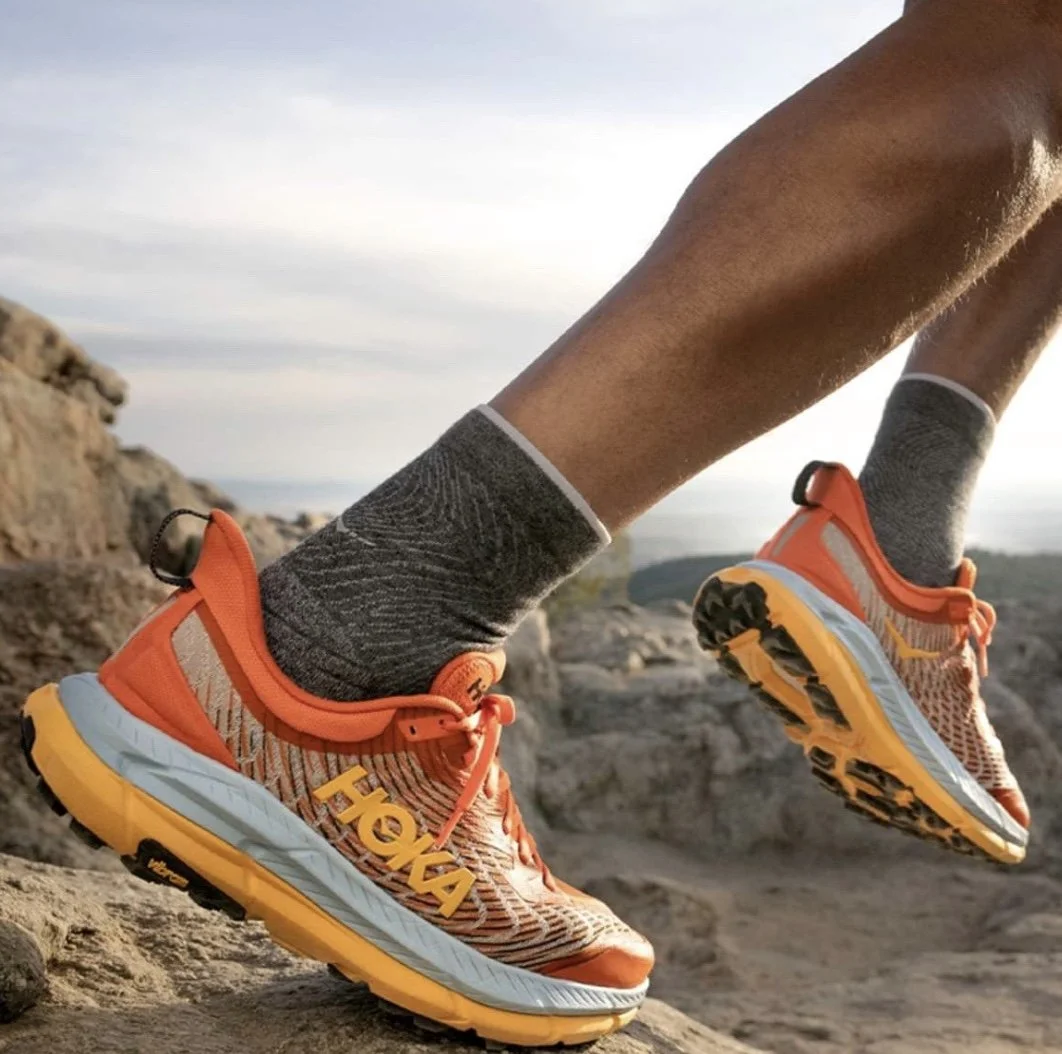
For years, I bought the same trail run shoe: the Hoka Mafate Speed 4.
It worked fantastically for me. After trying many different models and running thousands of kilometres in the mountains, I knew it with certainty: this was my shoe.
Of course, nothing lasts forever. Improvement is always possible — at least in theory. So when a successor was announced, the Hoka Mafate Speed 5, I was curious. When my last pair of Speed 4s finally died, I ordered the new model with genuine anticipation.
It was a complete disappointment.
The Speed 5 had almost nothing to do with its predecessor. It felt heavier, clumsier, fundamentally different. The geometry had changed. The cushioning behaved differently. Even the sizing no longer corresponded: the size that had fit me perfectly for years was suddenly too small.
And just like that, I was forced back into the market.
The Speed 4 was no longer in production, and finding remaining pairs became increasingly difficult. So I had to start over.
Drowning in the Review Ocean
I did what you’re supposed to do. I read reviews.
And immediately, you’re lost.
Each review introduces new models you’ve never heard of. Competitors you hadn’t considered. Shoes you’re told are “similar but better”. Those lead to other reviews, which reference still more shoes. The process is recursive. There is no bottom.
Worse: the reviews contradict each other.
A shoe is described as “plush and forgiving” in one place and “firm but responsive” in another. It runs “true to size” — unless your feet deviate from a norm that’s never specified. You start cross-checking, comparing reviewers rather than shoes.
Stack height. Drop. Foam density. Energy return. Torsional rigidity.
Parameters that might mean something in isolation but here form a maze with no exit.
What’s notably absent is time.
No one writes: after 500 kilometres this foam is dead. That kind of statement would introduce finitude. And finitude is bad for circulation.
So a machine emerges that feeds itself. Reviews reference other reviews. Models are endlessly compared. The user slides from option to option, drifting further away from the original goal: running — and enjoying it.
The Industrial Wasteland of Choice
Once you’re inside this maze, what opens up isn’t clarity but a landscape.
Not a poetic one, but an industrial wasteland where each brand has built its own settlement, complete with flags, slogans, and an internal road network readable only to initiates.
Take HOKA. What once consisted of a handful of clearly differentiated models now resembles a genealogical tree without a trunk: *Mafate, Speedgoat, Tecton, Challenger, Torrent, Zinal, Stinson*. Each name exists in multiple iterations.
At Salomon, the logic becomes abstract. Sense Ride, Sense Pro, Ultra Glide, S/Lab Pulsar, Thundercross, Genesis, Elixir. The names sound like fitness programmes or space probes. They suggest speed and progress. They say nothing about what it feels like to run six hours on tired legs with a descent that just keeps going.
La Sportiva goes further still: Bushido, Akasha, Mutant, Jackal, Cyklon. Shoes named as if you’re not running but role-playing. One is “more technical”, another “more playful”, a third “for long distances” — as if these categories excluded one another. Every season brings something new. Rarely does anything simply continue to exist.
What these brands share is not innovation but proliferation.
Models multiply faster than user needs. Differences between shoes are often smaller than differences in their descriptions.
This isn’t freedom of choice. It’s cognitive overload as a sales strategy.
The effect is predictable. The user begins to doubt their own experience. What worked yesterday becomes suspect today because six alternatives now claim to do it better. Stability is reframed as stagnation. Satisfaction as lack of ambition. If you don’t keep moving, you’re falling behind.
Extraction and the Endless Search
What’s happening here fits a broader pattern.
As Tim Wu describes in his book The age of extraction, modern markets increasingly shift from serving users to extracting value from them. What is being extracted is not only money, but attention: your search behaviour, your hesitation, your doubt, your time spent comparing. The goal is no longer arrival, but movement.
Cory Doctorow has described the same trajectory as a process of enshittification: systems that begin by serving users gradually reorganise themselves around internal incentives, until value is extracted while service deteriorates. What matters is not whether something works well, but whether it keeps circulating.
In physical markets, this logic does not appear as an interface or algorithm, but as something more diffuse: marketing. Not marketing as communication, but marketing as organising principle.
Seen from this perspective, the trail running market is not a curious exception. It is a clear illustration. Shoes no longer merely need to work. The system depends on uncertainty, novelty, and perpetual comparison. Satisfaction would break the cycle.
When Marketing Eats the Product
Marketing here is not an external layer added to an otherwise stable product. It is the mechanism through which extraction operates.
Visibility, hype cycles, and perpetual “innovation” begin to override a simpler question: does this product still serve its user?
Take HOKA. What began as a trail running company is now part of a publicly traded footwear conglomerate. Production is outsourced. Entire product lines are developed as lifestyle sneakers rather than technical tools. City shoes. Fashion objects. T-shirts, accessories, identity merchandise.
The core has been hollowed out.
What was built for runners has been repurposed for people who want to signal running without doing it. The actual runner — the person who needs shoes that function for thousands of mountain kilometres — becomes irrelevant to the business model.
The company no longer answers to use. It answers to its own marketing machinery.
Individual Pricing, Traceability, and the Illusion of Efficiency - Scarcity as Design
The most disturbing moment comes after comparison — when you try to buy.
The model exists. Reviews are recent. Photos are everywhere.
But your size is unavailable. Or only in a colour that costs sixty euros more. Or the price changes overnight without explanation.
This isn’t logistical failure. It’s design.
In a digital economy, prices increasingly reflect not a public standard but individual traceability. Your clicks, your searches, your hesitations are folded back into what you are shown and what you are asked to pay. Economists sometimes describe this as ideal market efficiency. But it is efficiency for the seller, not for the user.
Price ceases to be a shared reference point. It becomes personalised extraction.
Like airline tickets, volatility holds attention. Scarcity keeps you checking. Continuity would let you rest — and rest is dangerous to an extraction economy.
That is why models don’t disappear because they are bad, but because they are too good. A shoe that satisfies generates less movement than one replaced each season by something similar enough to appear related, yet different enough to restart doubt.
Markets dominated by hype become opaque. Prices fluctuate. Logic dissolves. The user loses any grip on what is reasonable.
Parallel Systems
Once you see this pattern, you see it everywhere.
Dating apps promise that the next swipe is better than the last. They depend on permanent incompleteness. A lasting relationship is economically irrelevant.
Job sites display positions open for months — not because no one qualifies, but because the process itself generates data, clicks, engagement.
Social media rewards visibility, not proximity. Engagement replaces relationship. The user stays active as long as they don’t arrive.
Even publishers follow trends this way. Not the manuscript that’s right, but the one that fits the moment. Continuity is boring. Renewal sells.
The shoe story is a prism: a small, tangible example where an abstract mechanism becomes visible.
Growth, Efficiency, and Who It Is For
This brings us to a question that is strangely absent from most debates about economic growth. The discussion is usually framed as a quantitative one: more growth or less growth. But that framing already misses what is most at stake. The real question is qualitative: what kind of growth, and for whom?
We can easily produce economic indicators that look excellent while the actual user disappears from view. Metrics that measure activity but not satisfaction. Transactions but not value. Movement but not arrival. Growth becomes a matter of throughput rather than use, velocity rather than care.
Underlying this is a broader social ideal: efficiency. Everything must be optimised. Time, attention, logistics, choice. Friction is treated as a flaw. Rest as waste. Any pause is a missed opportunity. But this ideal of efficiency is not neutral. It overwhelmingly serves those actors who are large enough to turn efficiency into dominance: companies that scale, platforms that concentrate, markets that tip toward monopoly.
In such a system, efficiency is never for the user. It is for those who can extract the most from the smallest margins, who can leverage data, attention, and dependency. What appears as rational optimisation from above is experienced below as constant pressure: to choose faster, decide better, keep up.
Walk into a Decathlon to buy sunglasses. For running. For cycling. For mountaineering. For water sports. Dozens of variants. It looks like abundance, but functions as disorientation. You are no longer a person with a need, but a consumer confronted with a test you are bound to fail. You haven’t done enough research. You’re already behind. Somewhere, there is always a better option you didn’t know about.
The only solution offered is more consumption. Buy again. Upgrade. Adjust. Optimize yourself. But you never arrive at the right product. You leave not feeling served, but subtly inadequate — as if the failure were yours.
This is not an accident. A system organised around extraction cannot afford users who are satisfied. Satisfaction ends movement. Continuity interrupts circulation. A product that works too well, for too long, is economically suspicious.
Rest as a Radical Demand
Seen from this perspective, the deepest problem is not inconvenience but a creeping hollowing-out of everyday life. A society governed entirely by efficiency produces people who begin to live like machines: managing inputs and outputs, optimising schedules, ticking off lists. What gets squeezed out are precisely the things that make life human: lingering conversations, care that takes time, activities that are not immediately productive.
In an economy where attention is constantly harvested, rest becomes a form of resistance. Insisting that something is good enough is almost subversive.
Perhaps the most radical demand we can make today is not for ever-new products, but for products that are allowed to remain. For systems that tolerate satisfaction. For markets that serve use rather than exhaust it.
Sometimes the most meaningful form of growth is not expansion, but restraint. And sometimes the most radical thing you can ask of an economy built on extraction is simply this: let what works continue to work.
PS: For anyone interested in the broader stakes of this logic — from monopoly power to attention capture to the hollowing-out of public life — I cannot recommend enough the wonderful conversation between Tim Wu, Cory Doctorow and Ezra Klein of the NYTimes. It is one of the clearest, most careful analyses of where this trajectory leads, and why the question of efficiency, left unquestioned, may cost us far more than it promises. https://www.nytimes.com/2026/02/06/opinion/ezra-klein-podcast-doctorow-wu.html
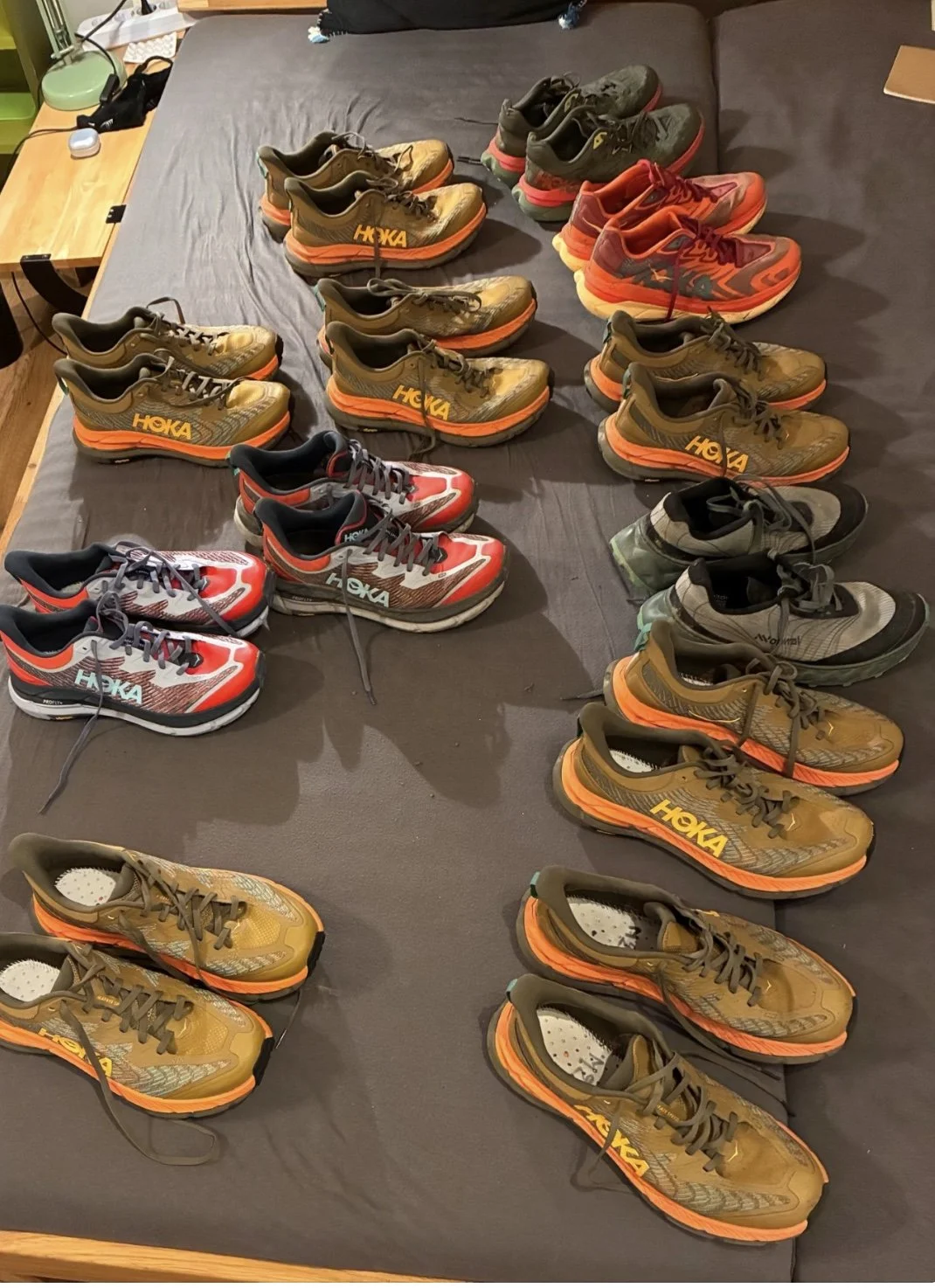
Part of my collection of used Hoka Mafate Speed 4 's. Sooner or later, they'll become a collector's item ;)